
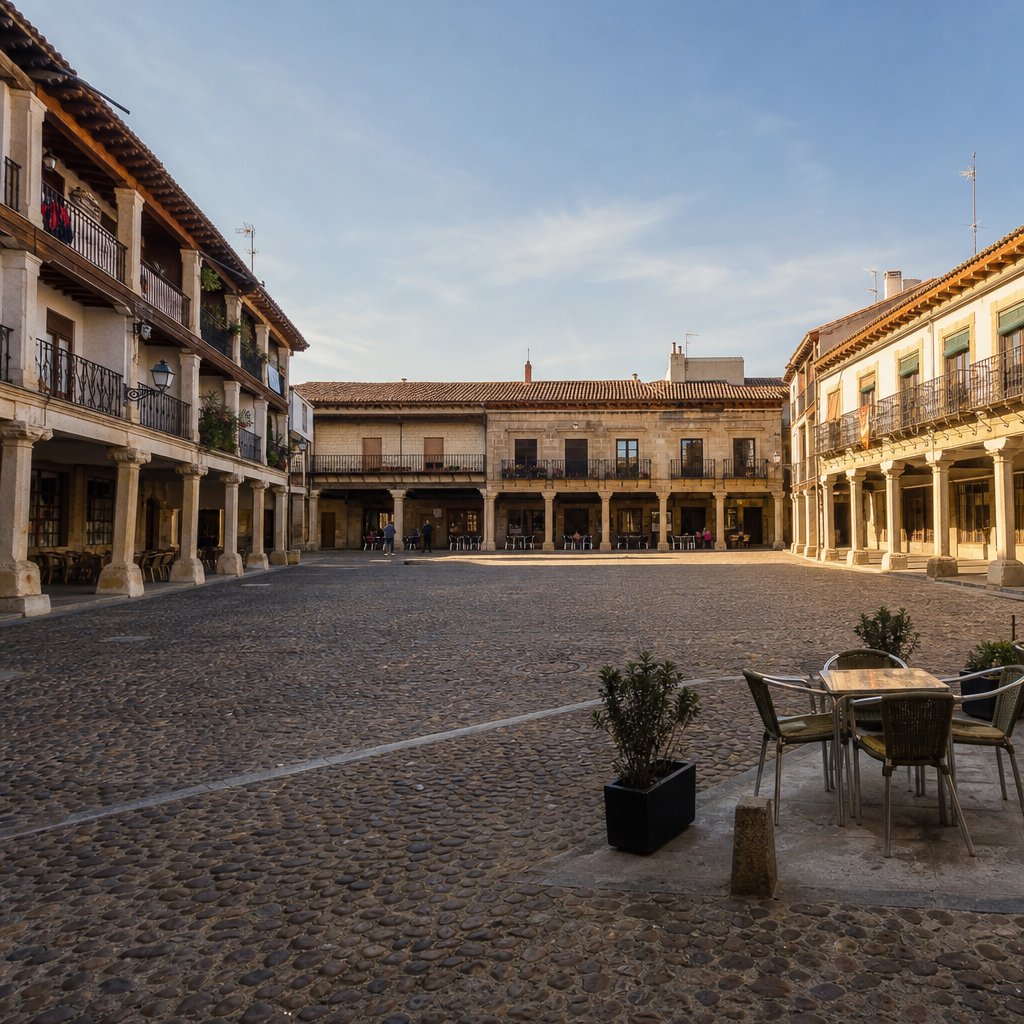
The old town's civic heart, then and now
Plaza de la Constitución
A rectangular square with 400-year-old arcades that's never stopped being the town's centre of gravity: the town hall still fronts it today, exactly as it has for centuries.
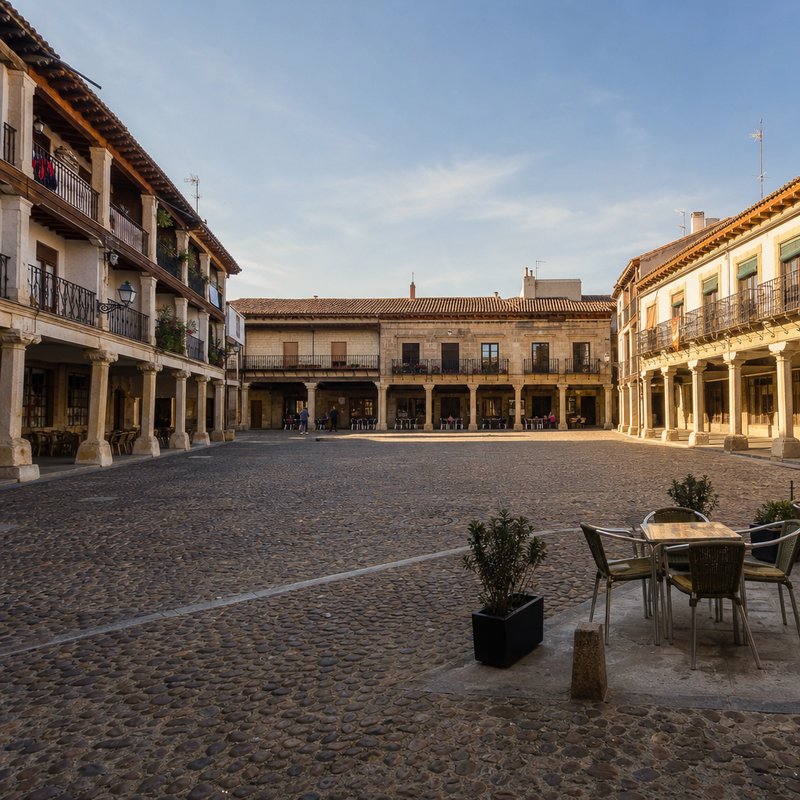
Built in stages, from the 16th century on
Construction of the square began in the 16th century and was consolidated through the 17th, with the pósito (a grain storehouse for poor farmers, funded by nobleman Antonio Correa "El Indiano") added in 1613. The square is rectangular, slightly sloped toward the north, and lined with the two-story arcades and balconies typical of Castilian town squares, except on the northern front, where the buildings rise a distinctive third storey.
Its current name honours Spain's 1812 Cádiz Constitution, a naming pattern shared with many Spanish town squares, though this one hasn't kept a single name throughout its history. It's also been known as "Plaza Mayor" and, during the Franco era, "Plaza del Generalísimo," before recovering the "Constitución" name.
A clock tower that moved
One of the square's most distinctive features, the Torre del Reloj (clock tower), was built in 1672 by Cristóbal Rodríguez de Jarama, but it wasn't always here. It originally stood on the parish church's own tower and was relocated to the square, atop the 1613 pósito, after 17th-century work on the church. The old Casa Consistorial (town hall building) traces municipal use back to 1566, when it housed the "Casas de la Audiencia," and was fully rehabilitated in 1994.
Still the civic centre, and a Feria Barroca stage
The Ayuntamiento de Valdemoro's official address today is Plaza de la Constitución nº 11. The town hall genuinely still fronts this square, not a symbolic claim. The plaza is listed in Spain's General Registry of Cultural Heritage Assets as a Bien de Interés Cultural (Historic-Artistic Monument), with protection built into the town's own urban land-use plan.
It's also one of the central venues for the annual Feria Barroca, when more than 100 stalls recreate a 17th-century marketplace across this square and several neighbouring plazas and streets in the historic centre.
A market square long before it was a fair venue
The square's role as a market venue predates the Feria Barroca by centuries: local historical sources describe it hosting weekly markets, annual autumn fairs, and even bullfighting spectacles going back to the 16th century, a genuinely old civic-square function, not something invented for the modern festival calendar. A newer municipal building, the Casa Consistorial Nueva, was added nearby in 1990 to house the town hall's growing administrative needs, a real 20th-century addition alongside the square's much older architecture. No source we checked gives an exact square footage or a precise arch count for the arcades, so we're not going to invent a figure either.
Find it on the map
Official page (Valdemoro Turismo)Common questions
Is the Valdemoro town hall on the Plaza de la Constitución?
Yes: the Ayuntamiento de Valdemoro's official address is Plaza de la Constitución nº 11, confirming the square is still the town's civic centre today, not just a historic one.
Why is the square called "Plaza de la Constitución"?
The name honours Spain's 1812 Cádiz Constitution, a naming pattern common across Spanish towns, though the square itself has carried other names through history, including "Plaza Mayor" and, during the Franco era, "Plaza del Generalísimo," before recovering the "Constitución" name.
Does the Feria Barroca happen on this square?
It's a central venue, though not the only one: the annual fair's 100-plus stalls spread across the Plaza de la Constitución plus several neighbouring plazas and streets in the historic centre.